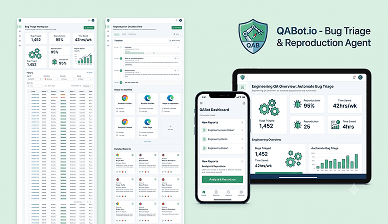
Engineering operations
Reference buildBug triage time cut by 70%
An agent that reads incoming bug reports, attempts reproduction from the available context, and routes what it cannot reproduce with the specific questions that would unblock it.
At a glance
- Duration
- 13 weeks
- Team size
- 1 person
- Engagement
- New build
- Project type
- AI & automation
- Industry
- B2B SaaS
Built with
The situation
The challenge
Most triage effort goes into reports that cannot be reproduced as written. The information needed is usually knowable, but asking for it is manual and repetitive.
What we did
Attempt reproduction automatically, and when that fails, ask precisely for the missing piece rather than sending a generic request for more detail.
The calls that mattered
Reproduction attempted before routing
The agent tries the steps against available context first, so a triaged bug arrives with evidence attached.
Specific questions, not 'please provide more information'
When reproduction fails, the agent names what is missing. Generic requests are why bug reports stall.
What changed
- reduction in triage time
- 70%reduction in triage time
- of unreproducible reports return specific questions
- 100%of unreproducible reports return specific questions
Triage time down 70%, with unreproducible reports returned carrying the specific questions that would resolve them.
Services used
- Automated reproduction attempts against report context
- Structured triage output with severity and routing
- Targeted follow-up question generation
What we would do differently
Every project has one of these. Publishing it is the point — a case study with no regrets in it is marketing, not evidence.
Knowing when to stop was the design problem. An agent that keeps trying to reproduce a bug burns more time than the triage it replaced.
More work
- Internet Money · Crypto financial services$10M+monthly transaction volume
One wallet interface across five blockchains
A multi-chain crypto platform where every chain hides behind one interface, with a tamper-evident audit trail underneath it. $10M+ moves through it monthly.
Read case study - MagicTask · Project management SaaS100K+concurrent users
From latency spikes at 5,000 users to 100,000 concurrent
A gamified project management platform re-architected from a single Node server into an event-driven system that holds 100,000+ concurrent connections without the reward engine touching the critical path.
Read case study